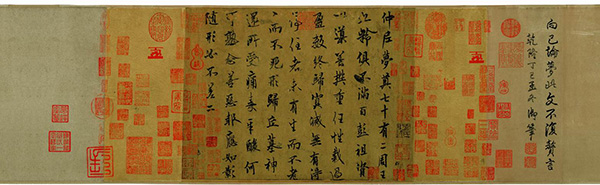
Tang Dynasty Calligraphy
Introduction
Tang Dynasty calligraphy holds a preeminent place in the history of Chinese art, reflecting the zenith of artistic refinement and cultural sophistication in ancient China. Known as a golden age of Chinese culture, the Tang era fostered a flourishing of calligraphy, regarded as one of the highest art forms.
This period not only witnessed the consolidation of earlier traditions but also saw the emergence of new styles and influential masters who defined the trajectory of calligraphy for centuries to come. Calligraphy in the Tang Dynasty (618–907) was closely tied to intellectual and social prestige, with scholars and officials often judged by their calligraphic skill. The era's emphasis on rigorous education and artistic expression elevated the status of calligraphy within the broader cultural landscape.
Historical Background
The Tang Dynasty was characterized by political stability, economic prosperity, and cultural exchange, creating fertile ground for artistic development. Calligraphy was integral to governance, education, and personal cultivation. The imperial examination system, which determined entry into government service, placed significant importance on calligraphic ability, reinforcing its role in societal advancement.
The Tang period also saw the codification of script types, building on the foundation laid by earlier dynasties. The primary scripts in use included kaishu (regular script), xingshu (running script), and caoshu (cursive script). Each script had distinct functions and expressive possibilities, allowing calligraphers to explore a wide range of artistic and practical applications. This era also marked a turning point in the theoretical discourse on calligraphy, with treatises and critiques that laid the groundwork for later generations.
Features and Styles
Regular Script
The Tang Dynasty is often associated with the perfection of kaishu, or regular script. This style, characterized by its clear structure, balanced strokes, and precise proportions, became the standard for formal writing. Ouyang Xun, Yan Zhenqing, and Liu Gongquan were among the most celebrated masters of this script. Ouyang Xun's works, such as the Jiucheng Palace Tang Tablet, exemplify meticulous craftsmanship and an emphasis on clarity. Yan Zhenqing introduced a dynamic energy to kaishu, blending vigor with elegance, as seen in his masterpiece Duo Bao Pagoda Stele. Liu Gongquan's approach, often described as “iron strokes and silver hooks,” emphasized austerity and strength.
Cursive Script and Running Script
Tang calligraphers also achieved remarkable innovations in caoshu and xingshu. These styles, used for more personal or artistic expression, allowed for greater fluidity and individuality. Zhang Xu, a leading exponent of cursive script, was renowned for his wild and unrestrained style, earning him the nickname "Mad Zhang". His works, inspired by emotions and spontaneity, pushed the boundaries of traditional calligraphy. Huai Su, another master of cursive script, created pieces such as the Autobiography, which demonstrated controlled chaos and rhythmic vitality. These calligraphers elevated cursive writing to a form of abstract art, capturing the dynamism of the human spirit.
Techniques and Materials
Tang calligraphy benefited from advances in materials and techniques. High-quality brushes, ink, and paper were widely available, enabling finer control and a broader range of expressive effects. Calligraphers paid close attention to the "four treasures of the study", perfecting their tools to achieve desired outcomes. Techniques such as varied brush pressure, speed, and angle allowed for diverse line textures and tonal variations. These innovations were pivotal in advancing calligraphy from a functional skill to a profound art form.
Legacy and Influence
The calligraphy of the Tang Dynasty set enduring standards for aesthetic and technical excellence. The works of Tang masters became benchmarks for later generations, influencing subsequent dynasties and regional traditions. Tang calligraphy also played a vital role in the dissemination of Chinese culture across East Asia, where it inspired local adaptations and schools of practice. The treatises and collected works of Tang calligraphers remain foundational texts for the study and appreciation of Chinese calligraphy today, underscoring the timeless appeal of this art form.








